Tuesday, March 18

google reader versus netvibes


I recently switched my browser homepage and overall RSS reader solution from netvibes to google's reader. For the most part, I'm happy with the switch, even with netvibes' recent rollout of their 'ginger' version and the social networking capabilities that come with it.

As Myer has heard me admit over and over, my guilty secret is that I often choose design aesthetics over functionality. The two aren't mutually exclusive of course, and I'm sure if you talk to any interface design specialist they'll talk your ear off about the beauty of a well designed functional interface. That said, I'll still sacrifice features for beauty in most cases. I'm guilty! For example, I develop websites in Firefox because it is far and away the best suited for the job: an extension called firebug is most of the reason why this is true, but the whole extension architecture available to firefox just makes it the most functionally robust browser out there. I'm typing this blog in Safari however, and I do most of my browsing here. It just looks so nice, and even though it lacks the huge feature set of Firefox, the interface design is amazingly clean and simple.

So I'm going against my instinct a bit by adopting google reader. I did find a skin for it that makes it look pretty - using it under safari is very nice. Ironically it was made by the guy who designed the logo for Firefox. I miss a few things about Netvibes functionally and interface-wise however:

  1. In netvibes, each feed has its own space on the page, so I can see at a glance what has been updated, and I like browsing by source like that. Google reader mashes everything together on one page and provides two options for viewing: the full post, which means you can see at most two or three posts at once; or a squished list with the first few words of the post visible, like gmail. I'm opting for the second view so I can see more of what's new at once, but that brings me to the second thing I miss:

  2. In netvibes, I could mouse over the title of a collapsed blog post on the front page and up would pop a lovely little AJAX floating summary near my mouse. All I had to do to quickly skim the first few paragraphs of all the new entries on my page was mouse over new posts. I could quickly get a sense of the things I wanted to read and click in from there to read longer posts. With google reader it's a bit more cumbersome - I do get to see the first few words of a post, but that rarely gives me a good sense of what I'm about to click into. In a perfect world, writers would write functional titles and opening sentences to give me a great idea of what I'm getting into. Course, that's not the case!


I'm sure this all sounds incredibly picky - but having a good interface to work with can be the difference between getting use out of a tool, and throwing the tool to the wayside. I have a feeling I'll be sticking with google - if only for the really fun 'share' feature. Also they pretty much own my life these days, so you know.

Sunday, March 16

be kind, rewind


Tonight I saw Michel Gondry's new film 'Be Kind, Rewind.' Going in to the film I was expecting a certain level of artfulness and humor that had been hinted at in the trailers and from what I knew of his previous work. What I didn't expect - what I was happy to find - was a social film with activism and community at its core; a vitality and humanity I've only seen in films close (in both history and ideology) to the events of May 1968, in particular Truffaut's 'Stolen Kisses.'

Stolen Kisses is a special product of a time just after student uprisings in France and all over the world had in some cases come close to toppling whole governments. You can feel a sense of an excited "what's next?" being collectively whispered throughout the film, and particularly represented in the young Antoine Doinel. It's an incredibly optimistic film, just on the edge of an emerging era and culture.

Be Kind Rewind gave me this same impression - but rather than simply attempting to recycle a forced agenda of revolution and optimism, the film seems as though it simply has no choice. It articulates itself essentially in the language and grammar of now: the trailing edge of globalized culture, which is no longer an impending and dreaded model trickling its way through our lives, but a critical and essential matter of the way we live. What is really interesting to me is that the way the film (and I would argue, culture on the whole) reclaims the conditions of globalized culture for the people is by the acute territorialization of culture. It's very important that we're witnessing the interactions of a specific small town in New Jersey, that we're seeing a microculture interacting with itself, but also and I think very critically, that we see it interacting with global culture.

Throughout the film we are constantly aware of a shared media reality - this small community acts it out by staging 'ghostbusters' or 'driving miss daisey' etc. This community takes ownership of the culture that has been disseminated from Empire, and which in this film is represented by the empire state: New York. Gondry does a wonderful and effective job in telling what is a recent story, and what stands to characterize this emerging century: the decentralization of cultural power and ideology. It sounds terribly cliche to speak of the 'youtube generation' for example, but it's worth pointing out that we're at a unique point in cultural history that is putting notions of authorship and authority that are really fairly young into question.

I had a short conversation with someone at the SPARK festival recently about how their students apparently had no qualms about drawing from a 'democratized pool' of sound bits and software tools, with absolutely no regard to authorship. He was lamenting the fact that he'd hear the breakbeat from 'funky drummer' in his student's music, and that they had no knowledge of its origin. My response was that I find this kind of loss of authorship extremely exciting, and I think it's representative of a potential for the creative act to re-emerge as a fundamentally community activity. Rather than looking at art and artwork as a product of individual genius, we are learning to understand it as a cultural communication. Be kind rewind understands this, and I was incredibly happy to see it articulated in such an ecstatic way. The film says "do" - and that's what we're doing.

Saturday, March 3

Drone Again

I'm so back onto drones. Was I ever off drones? I'm feeling that wave of "why would I ever listen to or make any other kind of music" again. Here's a short list of great drones:

  1. ghosting - their current myspace song.

  2. the dream syndicate (lamonte young, tony conrad, et al) - 2 iv 64

  3. lamonte young - dreamhouse 78'17

  4. lamonte young - the melodic version (1984) of the second dream of the high-tension line stepdown transformer from the four dreams of china (1962)

  5. tony conrad - pythagoras, refusing to cross the bean field at his back, is dispatched...


I also got a copy of Sun Circle, which is pretty much a cover album of Lamonte Young's rare Black Album by Greg Davis and Zach Wallace. I was SO excited about it when I ordered it. I need to listen to it again, but I wasn't super impressed on the first listen. There's a glacial-speed development that happens in lamonte young's best stuff, it almost becomes vertical - time stands on one end and begins to move straight upward. Sun Circle on first listen does a great job of apeing the aesthetic of the Dreamhouse stuff, but it just felt flat to me. I was in a terrible mood when I put it on though, so that might be it.

Sunday, February 4

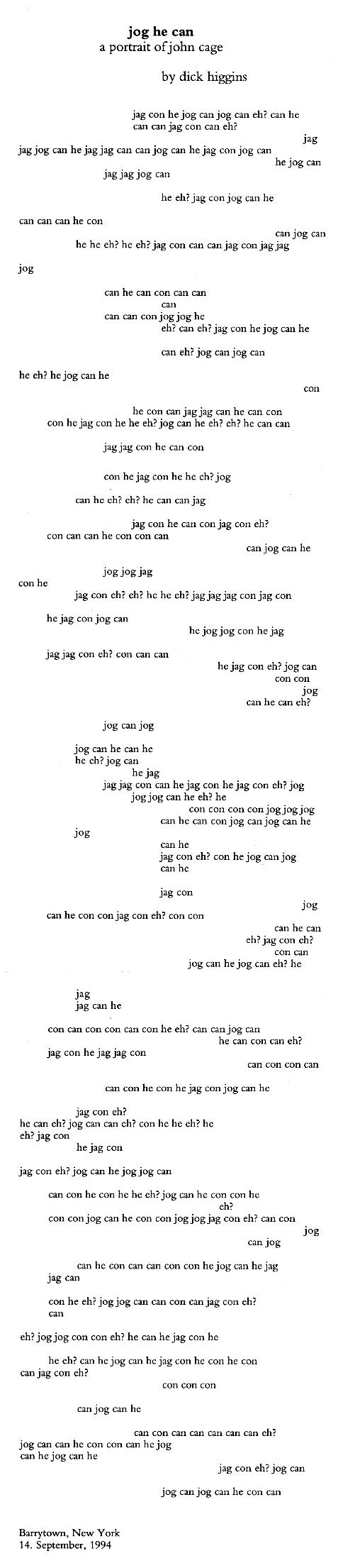
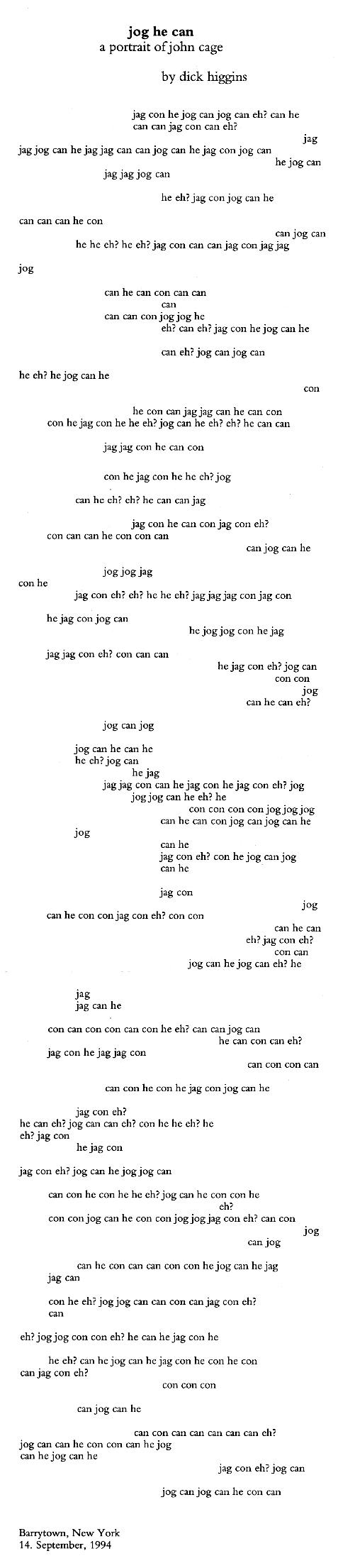
jog he can

I came across this poem dedicated to John Cage today. I guess i'm not in the mood for fluxus poetry today, but it was nice to see I'm not the first to anagram Mr. Cage.

I was in the mood to play the trombone today, which was the first time I sat down and practiced in months and months. I'm incredibly rusty, but working my chops back up to a passable quality was a lot of fun. I'm sure it annoyed the neighbors though.

What's annoying me right now is whether it's okay for me to sing a song about Jesus at my show on Saturday. I'm not religious, but tasteful devotional songs have recently been very comforting to me. I can't decide if my song would be insulting to a hypothetical Christian audience, despite the respect I intend in performing it. I may chicken out and just sing a love song instead... Those are always offensive to someone regardless.

Monday, May 29

Production and the Culture of Play

For me, and I think for Cage, Hardt, Negri, and Derrida at least - and probably others but definitely not everyone - what's at stake in all this sweating over theory and resistance is the preservation or maybe emancipation, or even deployment of play (depending on what stage we think we're at with play in our lives, if arriving at a diagnosis like that is even useful...). The problem with saying something like that is that resting on something like play obviously begs an outline of that thing: what exactly is play? Or maybe better - and a little more slippery - free play?

I think, like Chomsky says (I might be misinterpreting him, but this is what I hope he means) we need to be brave enough to act with incompletes - that is, we need to leap into control as far as we are able of the production of justice, even though we haven't arrived at Justice - and, of course we may argue that the entire idea of arriving at a coalesced thing Justice is both impossible and dangerous, etc etc: have your poststructrual field day here. So: I don't know what Play is any more than I know what Justice is, but in the spirit of theory complementing action, here's some grasping at a distinction that seems to me like an entry point for action.

Play, I think, is in danger of being confused with consumption - and I think that danger is largely due to influences of capitalist ideology. (Surprise! ;-) ) Play, I think, is a critically active and productive mode or pursuit or whatever. When I think of play, it's Cage developing strategies for sound, or it's my bud kev crafting a prototype for the compilation we're putting together, or it's Zizek watching Casablanca and cooking up his bit about Bogart and Bergman's sex and not-sex. The last example is where I think the danger slips in. The ideology of capitalism is such that value lies totally in the act of consumption - or at least, that "something more" that products promise is contained directly in the act of consumption. Consumption isn't the spark of a process, or a step along the way, it's a necessarily self-contained bubble of value: it not only doesn't require any response, I'd argue it encourages unresponsiveness - a kind of reverence for its doing a good job of providing the experience of consumption.

So, here maybe is a good place of distinction for what I think are the most exciting activist trends right now: institutions, loose collectives, products, and other mostly capitalist ephemera that not only leaves open a door to active production, but pretty much demands it. That's what I think the mark of play is: production. The production of an object, a community, or a discourse, whatever - but an active and critical production.

I read about a system that won an award at Ars Electronica which I think is a nice disruption of consumption - it makes a kind of injection of play into normal consumption. It's a website where you can enter the barcode of any product, and it will identify undisclosed ingredients, and provide access to a critical discussion about that product or its components. The idea is to eventually have support for cell phones, so you could go to the store, use your camera-phone to scan a barcode and read about some mysterious chemical listed on the side of your cereal, or whatever. This is an active kind of culture - it makes a space for play.

Now - already I think capitalist ideology and methodology is trying to swallow up what I'll go out on a limb and say is an explosion or at least the initial tremors of a culture of play. There's a television station that sells advertising by the year to companies like Sony, who don't then provide advertisements for their products - the station runs ads that it asks its viewers to make. I'm worried about things like that, the danger here is claiming play in the name of consumption, and remaking play so that it works for consumption. That TV station seems great - but I really doubt you'd see a spot about Sony that takes a critical position towards the company the way you might on youtube for example. What there will be is an ad that is at commercial quality, in the language of consumption, that uses the power of play to validate itself: "someone just like you made this themselves! it's part of who you are!"

I think one of the most important things to do right now at a time where the internet is in danger of losing its freedoms is to actively claim a culture of play, and deploy it in the face of consumption.

Tuesday, May 2

digitalization and slum-living

No time for commentary, off to work (in the wake of international worker's day!) but Zizek has made this point elsewhere, and I think it's fascinating - I hope not in any fetishistic way, but who knows. In a talk that you can download here he sets up the potential for new ways of living at the intersection of digitalization (and Gibson's cyberpunk novels come up here) and poverty/slum-living. I couldn't find a better quote, but he touches on the idea here:
While one should resist the temptation to elevate and idealize the slum dwellers into a new revolutionary class, it is extremely surprising how many of their features fit the old Marxist definition of the proletarian revolutionary class. Even more than the classic proletariat, they are “free” in the double meaning of the word—“freed” from all substantial ties and dwelling in a free space outside state and police regulations. They are large collectives, forcibly thrown into a situation where they must invent some mode of being-together, while simultaneously deprived of any inherited ethnic and religious traditions.
[...]
We should be watching the slum collectives for signs of new forms of social awareness: They will be the seeds of the future.

The article is here, and the mp3 is here (search the 2004 mp3 page for Zizek, he's buried a bit near the bottom of the page).

Monday, May 1

Temporary Services


There is no longer any social necessity for human beings to be treated as mechanical elements in the productive process; that can be overcome and we must overcome it by a society of freedom and free association, in which the creative urge that I consider intrinsic to human nature, will in fact be able to realise itself in whatever way it will. [...] If we are thinking of social transformation or social revolution, though it would be absurd, of course, to try to sketch out in detail the goal that we are hoping to reach, still we should know something about where we think we are going, and such a theory may tell it to us. [...] It is of critical importance that we know what impossible goals we're trying to achieve, if we hope to achieve some of the possible goals. And that means that we have to be bold enough to speculate and create social theories on the basis of partial knowledge, while remaining very open to the strong possibility, and in fact overwhelming probability, that at least in some respects we're very far off the mark. - Noam Chomsky in conversation with Michel Foucault, 1971
I think critical theory can learn something from this position, and from experimental science (as far as I understand it anyway). In physics, it seems to me, that the best theoretical physicists and the best experimental physicists would make Foucualt happy - they never allow themselves to feel too confident about the axioms they deal with, and test everything again at every chance. I think of Richard Feynman especially when I say that, but I'm sure if I knew more about other good scientists (lauded and invisible both) it would apply to them as well. So the best physicist is in a sense, a wonderful post-structrualist: self-reflexive, metacritical, ready to deconstruct in the face of ritual and common sense. What Chomsky opines to Foucault, though, and what I think is often the missing frosting on the cake of deconstruction, is this kind of boldness to say "okay, we have a pretty good idea what we're after, lets take a step forward and be ready to shift directions along the way." Chomsky is talking about constructing theories - but what he's after is an out-of-the-laboratory wielding of shaky theoretical terms like justice for example. As ready-to-break as the concept may be, we have to be bold enough to push it beyond its limits into practice and action - always looking to the laboratory for the new ready-to-break model.

I'd like to try to tie together a few ideas that seem to me to resonate well together. To start, here's a list:

• Cageian free play. Cage's zen aesthetic of no-aesthetic or maybe, all-aesthetic, was futuristic - he was invested in the idea (that is becoming material) that technology would bring society into a position where its primary activity could be peaceful and spontaneous free play, rather than a struggle for survival. I wouldn't call it so very different from Derridian free play, though Derrida might be utopian in a different sense - the practical impractical utopian.
• Empire and the network of the multitude. Negri and Hardt set the stage for free play - or, at least, the potential for it. Empire is built on an infrastructure that could support free play, but while a push towards the repurposing of Empire is imminent it is probably in its infancy.

Activist culture, I'm happy to observe, when it isn't apathetic (that's an odd too-common phenomenon, apathetic activism...) is wonderfully and loosley pointed in the above direction. The network is the operative concept in art and culture it seems - and this network is exactly the infrastructure I mentioned that is giving up so much promise of an in-this-lifetime (maybe) free play. Check out the group Temporary Services for evidence.

I listened to an interview with Michael Hardt (Empire co-author) a night or two ago, and the interviewer asked him why he and Negri were so recklessly optimistic. He pointed to a long tradition of communist and activist optimism - of treating defeats as the seeds of victory. He brought up Marx's metaphor of the mole burrowing and burrowing with every action, positioned to break to the surface. I'm optimistic.

Friday, April 14

Radical Verses


I had a conversation with Melanie last night about activist methodology. For this project I'm working on, format and tone is important - I'm working on it for selfish reasons, but I'm also hoping to contribute to the already bubbling discourse on aesthetics and life - so I'd like to find a way to present my ideas that won't come off abrasively.

This morning, reading through the Dhammapada, I realized that it was a wonderful model of a radical activist work. Here's a bit from it:
Those who take the non-real for the real and the real for the non-real and thus fall victims to erroneous notions, never reach the essence of reality.

Having realized the essential as the essential and the nonessential as the nonessential, they by thus following correct thinking attain the essential.
So, for now, I'm working with the idea of writing an essay, and then boiling it down into verses, and repeating for every section of this project. I haven't been able to let go of that traditional essay format entirely - I'm a parenthetical statement, constant footnote kind of guy, I need to work with a rhizome of interconnecting statements - but the idea of pairing essays with clean (at least on the surface) verses seems like just the right thing. Douglas Hofstadter did it in his own radical activist work, Godel, Escher, Bach, with his pairing of essays and fantasy dialogs.

And Cole Swenson seems to be doing it in her poetry. Radical verses seem to have just the right amount of ambiguity and room for free play - though, I'm still a fan of the complementary essay. (Swenson scholars seem to be too ;) )

Wednesday, April 12

Structuring Aesthetics


I'm going back to Antonio Negri and Michael Hardt's Empire now that I have the time to give it the attention it deserves. This is the first step into a project I hope to spend a few years on, and that will hopefully materialize at some point (or several points) as an essay or a book - or maybe a generative web-based installation, we'll see what the best format will be. The project is essentially driven by a question that has bothered me for years - since I began to look at what I do creatively in a critical light.

I'm interested in taking a que from Foucault, to examine the patterns and ripples surrounding the production of aesthetic objects. I'm using all those words in a really broad sense - by aesthetic object I mean a painting or a song as much as I mean a community or an event. I'm interested in the deep structure of functional aesthetics - that is, I want to look at how art and artful practice (ideally in the spirit of Derridian play, or Cageian play, but also the artful practice of propaganda, coercion, and other manifestations of power for example) are components of living, how they might produce meaning, or how they might be symptomatic of ideologies. It seems to me that the aesthetic and the functional can't be seperated, and that I'll need to look at one as a component of the other, and the other way around - Myer and I have had some nice discussions on this topic. It also seems like the conflict between the self and the multitude, or the self and the other will be a rich area to look into. I'm launching out from a Marxist base because it feels the most solid - we'll see where I might land.

Wherever it is, I want to arrive firmly in the arena of the real - that is, i'd like to develop a methodology by working through these theories. I'll say plainly that I'm working with an activist's mindset, and I want to come away from this with a toolset I can utilize in my creative work and elsewhere.

After I finish Empire right now I think i'll move onto A Hacker Manifesto - Wark's definition of a hacker as an information producer, and a special emerging class in the information age rubs me the right way.

(ps, i was lucky enough to find the same photo i used the last time i posted about negri, but with more of negri's office visible - hopefully that will be a nice complement to my understanding of his book this time around. i'd like to see a little more of his office ;-) )

Monday, December 19

The Revolution will not be Televised


Just a little Zizek-inspired thought before bed.

I remember in high school being elated at the wisdom of two lyrics from musicians I had breif and intense obessions with:

One: "The revolution will not be televised, brother!" Which was Gill Scott-Heron's exclamation in his poem of the same name. Scott-Heron is a kind of radical black slam poet and soul musician.

Two: "Sister had a birthday, won't be televised. [...] Smash the magnavox!" Which was the Blue Meanies - a noise-ska band.

I only made the connection that this sort of thinking was misdirected, misleading, inaccurate, self-defeating, etc once I read Antonio Negri's Empire. Zizek reminded me of it a moment ago.

Of course the revolution will be televised - not only will it be televised, but it will face its greatest threat by being televised. This is an easy and effective way for the dominant ideology to keep radical thought in check. Theres an over-saturation of representation of 'you and I' on television - we're on all the time, the revolution makes it to every episode of 20/20 and 60 Minutes. The only way to oppose the dominant ideology is to turn its own methods to progressive use. Echoing Scott-Heron and the Blue meanies (we're being repressed, we aren't allowed to fit in!) just reinforces the culture of otherness that has been built around this pervasive saturation of the everyman...

Okay, enough for now. Just thought it was funny that I was directing my indignation in a totally naive way for years (not to say I see the light now, but at least that's one veil lifted)...